Showing posts sorted by relevance for query fdr. Sort by date Show all posts

Tuesday, December 2, 2008

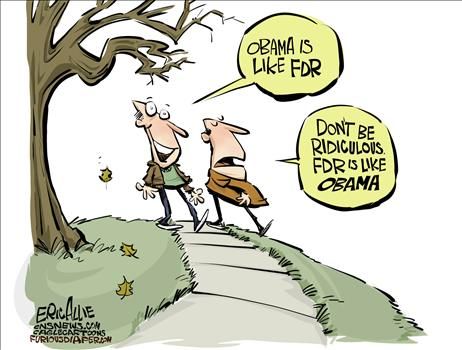
Barack Obama and the FDR-Great Depression Myth

The cover of Time magazine has Barack Obama photoshopped into Franklin Delano Roosevelt’s famous convertible, complete with oval-shaped glasses and cigarette holder held between the teeth. “The NEW New Deal,” The cover reads. Surely many who voted for Obama saw him as potentially the new FDR, the man to lead us out of hard economic times. But they’ve been misled, for even FDR wasn’t FDR. He is a quasi-mythical creature who not only didn’t end the Great Depression but probably greatly prolonged the nation’s economic agony with his New Deal programs and a menagerie of other foolish measures. Just look at the numbers... [click to enlarge]


Other economists, including Nobel Laureate Robert Lucas Jr. and the late Leonard Rapping concluded that the steady expansion of the money supply, but for FDR’s influence, should have ended the Depression in 1935. Even FDR Treasury Secretary Henry Morgenthau admitted the New Deal had failed.

“We are spending more than we have ever spent before and it does not work,” he declared in 1939. “We have never made good on our promises...I say after eight years of this Administration we have just as much unemployment as when we started...And an enormous debt to boot!”
Yet Obama apparently either doesn’t know his history or doesn’t care. He’s just proposed what one news outlet called “a monster new 'new deal,'” supposedly a two-year plan aiming to create or protect 2.5 million jobs with massive deficit spending...

READ MORE

Monday, July 6, 2009

You Know The Real Reason Why Time Mag Is Going Down the Drain? The Content.


Sample verbiage:

It's old news that F.D.R.'s New Deal did not end the Depression....F.D.R. appreciated the irony that it was the Depression that made it possible for him to realize those larger objectives.

It would be too much to say that he deliberately prolonged the crisis to preserve the possibilities for reform. But he candidly acknowledged the relationship between peril and progress in his second Inaugural Address, on Jan. 20, 1937....

President Obama knows this. Asked by PBS news anchor Jim Lehrer in February if he did not feel burdened by the several crises now besetting the country, Obama noted that the moment "is full of peril but full of possibility" and that such times are "when the political system starts to move effectively."


Roosevelt could not have said it better. F.D.R. championed a long-deferred reform [vs. rejected bad ideas] agenda that put security [vs. government control] at its core. Obama wants to advance another set of reforms [vs. government expansions] that have long been stalled [vs. vetoed by the people].

Given that it's such old news that the New Deal was an economic flopperoo and that President Obama is pushing a New Dealish-like economic stimulus package, you'd think that maybe Time would be interested in engaging the whys and wherefores of such things. Or in anything like a critical analysis of FDR and BHO. It needn't be negative or libertarian, but something other than idle idol worship might actually pull some eyeballs.

Check out Radley Balko and Jeff Winkler's great social-panic stories from the past four decades of Time here.

In any case, what can Obama learn from FDR? Plenty. Especially what not to do during an economic downturn. Just watch below...


[Highly Recommended {above}]
.

Monday, January 12, 2009

Obama's Choice: FDR or Reagan

FDR's answer: vast federal spending, tough new regulations on business and higher taxes -- like Herbert Hoover before him, only more so.

The Depression lasted until war orders from the Allies brought U.S. industry back to life. Before 1940, not once did unemployment fall below 14 percent. In May 1939, Treasury Secretary Henry Morgenthau testified:

"We are spending more money than we have ever spent before, and it does not work. ... I want to see this country prosperous. I want to see people get a job. I want to see people get enough to eat. We have never made good on our promises. ... I say after eight years of this administration we have just as much unemployment as when we started ... and an enormous debt, to boot."
But politically, the New Deal was a smashing success*, with FDR's landslides in 1932, 1934 and 1936 virtually wiping out the GOP.

Yet, economically, the New Deal was a bust, failing utterly to restore prosperity. Despite the indoctrination of generations of schoolchildren in New Deal propaganda, that is the hard truth.

Consider, now, how Ronald Reagan responded to the economic crisis of 1980, the worst since the Depression. In the "stagflation" of that Jimmy Carter era, interest rates had reached 21 percent and inflation 13 percent.

Reagan's answer was a tight money policy and across-the-board tax cuts of 25 percent, while slashing the highest rates from 70 percent to 28 percent. While unemployment hit 10 percent in 1982 and Reagan lost 26 House seats, in 1983 the tax cuts kicked in.

From there on out, it was boom times until Reagan rode off into the sunset, having created 20 million new jobs. "The Seven Fat Years," author Robert Bartley called them. Reagan had followed the lead of Warren Harding and Cal Coolidge, who had cut Woodrow Wilson's wartime tax rates of near 70 percent to 25 percent, resulting in "The Roaring '20s," a time of unrivaled prosperity.

The JFK tax cuts of the 1960s, also a Reagan model, were equally successful.

Harding, Coolidge, JFK and Reagan all bet on the private sector as the engine of prosperity. All succeeded. Franklin Roosevelt bet on government. And the New Deal failed. It was World War II that pulled the United States out of the Depression ditch of the 1930s.

[* but politically, it buys politicians indentured voters - and I fear Obama will have the same 'success' FDR did - and failure.]

READ MORE

Friday, November 14, 2008

So Now Time Tells Us: Obama The New FDR

.


Remember back during the campaign, when the Obama folks and their MSM cohorts adamantly denied that their man was a liberal? That National Journal study that ranked him the most liberal senator? Nonsense! Very misleading. After all, this is the man with a history of reaching across partisan lines (even if no good examples were handy at the moment).

So . . . remember all that? Well, forget it.

Now that Obama is safely ensconced in his Office of the President-Elect, the MSM can let the [ill-concealed to many of us] cat out of the bag: yes, he's a liberal. Big time! In fact, Obama is nothing less than the second coming of the biggest American liberal icon of all time: FDR! Rick Stengel announced the news on today's Morning Joe:

RICK STENGEL: It's the New New Deal, and it's Barack Obama as FDR, obviously. And it's about how he could forge a Democratic majority, a liberal majority, not unlike what FDR did.

READ MORE

Thursday, February 12, 2009

The Buck Always Stops with Taxpayers

.
Obama administration officials have their talking point down pat – “everything is still George Bush’s fault.” They only have one, because it has worked so well for them to date.

When Obama took office less than a month ago, the federal deficit was at a staggering $10 trillion after almost eighty years of constant deficit spending by congress, including the $1 trillion bank bailout passed by Bush and the Democrat congress in the final weeks of the Bush administration.

Since Obama took office a short three weeks ago, he has proposed a second $1 trillion “stimulus package,” which reads like the greatest pork orgy in human history, and makes FDR’s New Deal look like a Raw Deal for Americans permanently affixed to the public teat.

Now his new financial genius Tim Geithner, who can’t even figure out his own personal taxes and was directly part of the massive banking and market crisis that led us where we are today, is proposing another $3 trillion in so-called “bank stabilization” funds, and they are just getting warmed up.

That’s $4 TRILLION in NEW taxpayer debt in just three weeks in office. A 40% increase in the overall national debt in less than a month… and still counting.

Of course, this is in addition to the more than $3 trillion annual federal budget consumed by past spending decisions.

23% to pay for Medicare and Medicaid (FDR New Deal)
21% to pay Social Security benefits (FDR New Deal)
17% in so-called “discretionary spending” (earmarks and pet pork)
10% in “other mandatory spending” (mostly administrative costs)
8% just in interest on our outstanding national debt (and growing)

What’s the Rush?

The American people are being told that the rush to pass this socialist spending spree is an effort to look after them, and avoid total imminent collapse of the free market. But more than 65% of the current spending is not to be spent for more than 18 months. Over 60% of the spending in the bill is completely unrelated to economic stimulus…

They are certainly in a rush to do something, but clearly, it isn’t to stimulate the free market economy. So what is it?

[in a word? power]

READ MORE

Tuesday, February 3, 2009

How Government Prolonged the Depression

Policies that decreased competition in product and labor markets were especially destructive.

The New Deal is widely perceived to have ended the Great Depression, and this has led many to support a "new" New Deal to address the current crisis. But the facts do not support the perception that FDR's policies shortened the Depression, or that similar policies will pull our nation out of its current economic downturn.

The goal of the New Deal was to get Americans back to work. But the New Deal didn't restore employment. In fact, there was even less work on average during the New Deal than before FDR took office. Total hours worked per adult, including government employees, were 18% below their 1929 level between 1930-32, but were 23% lower on average during the New Deal (1933-39). Private hours worked were even lower after FDR took office, averaging 27% below their 1929 level, compared to 18% lower between in 1930-32. [snip]

Why wasn't the Depression followed by a vigorous recovery, like every other cycle? It should have been. The economic fundamentals that drive all expansions were very favorable during the New Deal. Productivity grew very rapidly after 1933, the price level was stable, real interest rates were low, and liquidity was plentiful. We have calculated on the basis of just productivity growth that employment and investment should have been back to normal levels by 1936. Similarly, Nobel Laureate Robert Lucas and Leonard Rapping calculated on the basis of just expansionary Federal Reserve policy that the economy should have been back to normal by 1935.

So what stopped a blockbuster recovery from ever starting?

The New Deal...

[Highly Recommended > ]

READ MORE

Wednesday, December 3, 2008

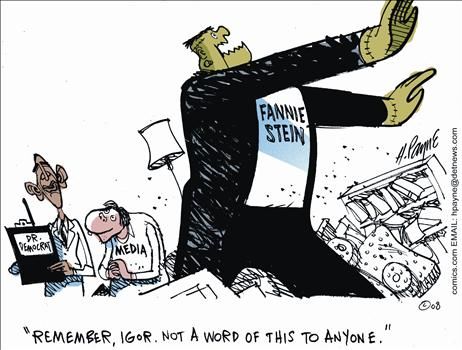
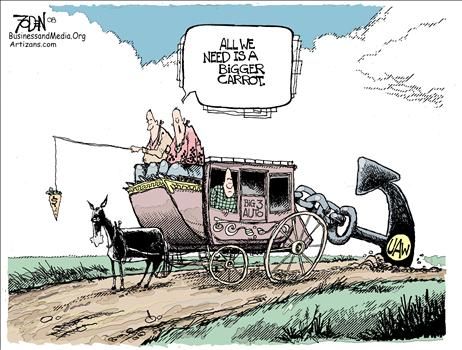
Giant Sucking Sound

[HT:BL, toons = 'staff']
Mr. Obama's one deeply false note during the campaign was his harping on "deregulation" as if that were the source of current troubles. His real problem is the crack-up of the world FDR built.

Fannie Mae was a New Deal creation, subsidizing the securitization of mortgage debt. FDR's successors piled on the subsidies for housing debt and incentives directed at low-income borrowers. Kaboom.


Then there's the UAW, born in 1935. For decades the UAW steadily traded away domestic auto market-share to imports and transplants to keep its aging membership toiling away toward their golden pensions and collecting wages and benefits twice those of their competitors. Kaboom.


Mr. Obama must be looking around and beginning to suspect he will be pouring his political capital, along with considerable taxpayer capital, down bottomless holes for the next four years.

He won't be building a legacy as the new FDR, but cleaning up after the last one...
[one hopes]


READ MORE

Wednesday, March 4, 2009


A Focus on Facts

Barack Obama, it is said, will inherit the worst times since the Great Depression. Not to minimize the crisis we are in, but we need a little perspective here.

The Great Depression began with the Great Crash of 1929. By 1931, unemployment had reached 16 percent.

By 1933, 89 percent of stock value had been wiped out, the economy had shrunk by one-third, thousands of banks had closed, a third of the money supply had vanished, and unemployment had reached 25 percent -- among heads of households. And in those days, there was no unemployment insurance, no Medicare, no Medicaid, no Social Security, no welfare.

FDR's answer: vast federal spending, tough new regulations on business and higher taxes -- like Herbert Hoover before him, only more so.

The Depression lasted until war orders from the Allies brought U.S. industry back to life. Before 1940, not once did unemployment fall below 14 percent [11 years]. In May 1939, Treasury Secretary Henry Morgenthau testified:

"We are spending more money than we have ever spent before, and it does not work. ... I want to see this country prosperous. I want to see people get a job. I want to see people get enough to eat. We have never made good on our promises. ... I say after eight years of this administration we have just as much unemployment as when we started ... and an enormous debt, to boot."


Politically, the New Deal was a smashing success, with FDR's landslides in 1932, 1934 and 1936 virtually wiping out the GOP.

Yet, economically, the New Deal was a bust, failing utterly to restore prosperity. Despite the indoctrination of generations of schoolchildren in New Deal propaganda, that is the hard truth.

Consider, now, how Ronald Reagan responded to the economic crisis of 1980, the worst since the Depression. In the "stagflation" of that Jimmy Carter era, interest rates had reached 21 percent and inflation 13 percent.

Reagan's answer was the tight money policy of Fed Chairman Paul Volcker and across-the-board tax cuts of 25 percent, while slashing the highest rates from 70 percent to 28 percent.

While unemployment hit 10 percent in 1982 and Reagan lost 26 House seats, in 1983 the tax cuts kicked in.
From there on out, it was boom times until Reagan rode off into the sunset, having created 20 million new jobs. "The Seven Fat Years," author Robert Bartley called them.

Reagan had followed the lead of Warren Harding and Cal Coolidge, who had cut Woodrow Wilson's wartime tax rates of near 70 percent to 25 percent, resulting in "The Roaring '20s," a time of unrivaled prosperity.

The JFK tax cuts of the 1960s, also a Reagan model, were equally successful.

Harding, Coolidge, JFK and Reagan all bet on the private sector as the engine of prosperity. All succeeded. Franklin Roosevelt bet on government. And the New Deal failed. It was World War II that pulled the United States out of the Depression ditch of the 1930s.

Comes now the financial collapse and economic crisis of 2008, inherited by Obama, with 40 percent of all stock values wiped out in a year, foreclosures pandemic, and unemployment near 7 percent and surging.
In crafting his solutions, Obama seems to be brushing aside the Reagan, JFK and Harding-Coolidge models, and channeling FDR and the New Deal Democrats.

Already staring at a $1.2 trillion dollar deficit for the year ending Sept. 30, about 8 percent of the entire U.S. economy, Obama has added a $1 trillion, yet another 5 percent to 7 percent of gross domestic product. The resulting deficit are twice as large as Reagan's largest, 6 percent of GDP, which was the largest since World War II.

And how is this Niagara of money to be spent?

Hundreds of billions will go out in checks of $500 to $1,000 to wage-earners and individuals who do not even pay taxes. This is much like the George McGovern "demogrant" program of 1972, where every man, woman and child, if memory serves, was to get a $1,000 check from the U.S. government.

Other hundreds of billions will go to shore up state and municipal spending. Other hundreds of billions will go for "infrastructure" projects, another name for earmarks, which is a synonym for pork.

Now, as Obama does not intend to raise taxes, at least now, he is going to have to borrow this near $2 trillion from foreigners or U.S. taxpayers, or the Fed will have to create the money. Undeniably, this will have an impact upon the economy. But what will that impact be?

Where in history, other than World War II, is there evidence that such a mass infusion of spending restored prosperity?

Obama and the Democrats are taking a historic gamble, not only with their careers but with the country. If this monstrous stimulus package, plus the trillions in hot money, do not work; if the two ignite rampant inflation, rather than real growth, we are all out of options. The toolbox is empty.

And what will follow may truly resemble the 1930s.

[didn't snip source URL, apologies]

Thursday, January 8, 2009

About That New New Deal

history
A series of recent books has demolished the myth. Some of Roosevelt's reforms were salutary (the Securities and Exchange Commission, reform of the Federal Reserve) but the New Deal's chief object was never achieved -- it did not solve the nation's unemployment problem.

The CATO Institute's Jim Powell points out in "FDR's Folly," "From 1934 to 1940, the median annual unemployment rate was 17.2. At no point during the 1930s did unemployment go below 14 percent. ... Living standards remained depressed until after the war."

Stanford University history professor David Kennedy has acknowledged, "Whatever it was, the New Deal was not a recovery program, or at any rate not an effective one."

On balance, the New Deal damaged the nation profoundly by extending and deepening the Great Depression. No other downturn in American history lasted so long or afflicted so many.

So no repeats, thank you very much.

READ MORE

[meanwhile, in the media...


NNBrief FLASHBACKs x9:
http://netizennewsbrief.blogspot.com/search?q=fdr
.

Friday, November 21, 2008

Media and Academia, Historical Illiterates du Jour

To show how foolishly hyperbolic the Old Media and the ignorati in our universities are, the Associated Press issued a dire report that breathlessly informed us all that Barack Obama is facing a "nation in crisis" and it's all "just like Lincoln and FDR." The AP even gets an historically illiterate university professor to sonorously declare how Obama is "one step away" from Lincoln and FDR.

But a review of our nation's real history shows that the America Obama will inherit is in nowhere near the state of crisis that Lincoln and Franklin Delano Roosevelt had to deal with. But, in the end, this isn't about real reporting or true historiography but about pumping Obama up and trying to shoehorn him in among what are considered by many our greatest presidents before he's even taken office.

READ MORE

Thursday, March 11, 2010

The Keynesian Stimulus Dogma

Subject: txt mny -
Blindness to history.

The Keynesians' faith in deficit spending as the key to economic recovery represents a triumph of hope over experience.

Exhibit A: The massive deficit spending of Franklin Roosevelt in the 1930s didn't stop the Great Depression. In fact, despite FDR spending more money in his first five years in office than all 31 prior presidents combined, his Secretary of the Treasury Henry Morgenthau stated in 1939 that "[w]e are spending more than we have ever spent before and it does not work. ... I say after eight [sic] years of this Administration we have just as much unemployment as when we started ... And an enormous debt to boot!"

Exhibit B: The massive deficit spending of Japan's government over the past two decades has led to protracted economic sluggishness. Japan still limps along, but now the nation suffers from the largest debt-to-GDP ratio of the developed world at almost 200%.

Exhibit C: Last year's so-called stimulus plan has produced the same results as FDR's stimulus-stagnant employment and mushrooming debt.

The Keynesian economists have a huge blind spot when it comes to history. That is because they tend to view economic history as divided into two eras: the years since the Keynesian revelation (Dec., 1935, when the master, John Maynard Keynes, enlightened the world with his General Theory of Employment, Interest, and Money, and pre-1935 when all was supposedly darkness. They seem oblivious to the historical fact that, before Hoover and Roosevelt, Uncle Sam didn't ramp up spending during recessions /depressions, and those downturns were of shorter duration.

The most instructive example is the Depression of 1920-21, which featured the most rapid fall in production, employment and GDP in our history. Rather than trying to stimulate the economy, Presidents Harding and Coolidge slashed government spending in half. Markets made the necessary adjustments, the depression lasted for approximately a year, and employment and production made rapid, robust recoveries.

[More, Recommended > ]

READ MORE

Tuesday, July 22, 2008

FDR UPSIDE DOWN

Since Franklin Delano Roosevelt (FDR) created Social Security, the system has always been based on the principle that as workers' wages rise, so do the taxes they pay, and so do the benefits they will get from the system. Sen. Obama would do away with this principle by requiring higher-end workers to pay taxes without getting any extra benefits linked to their higher contributions.

This would be a big step toward turning Social Security from a contributory pension scheme into just another welfare program.

• He would apply the Social Security tax to incomes above $250,000, in addition to the current tax on incomes up to $102,000.
• On incomes over $250,000, he would also impose a 4.6 percentage point hike in the personal income tax rate, a loss of some itemized deductions, and a 12.4 percentage point hike in the Social Security payroll tax.
• A high-income entrepreneur would see his or her federal marginal tax rate rise to 53 percent from the current rate of 37.7 percent; a rate higher than during the disastrous economic years under Jimmy Carter, when the maximum tax on an entrepreneur was 50 percent.
• The after-tax profits of an entrepreneur earning $500,000 would be reduced by $70,000 -- $56,000 in lost profits and $14,000 more in taxes -- just to produce a net revenue gain to the government of $14,000.
The private sector would be made $5 poorer in order to make the government $1 richer.

The calculated political design of the proposal indicates that what is really on offer is not some post partisan approach to politics, but rather a Democratic candidate far to the left of Bill Clinton...

READ MORE

Wednesday, September 9, 2009

FCC 'Diversity' Chief Asked Liberals to Fight Limbaugh

.
Obama's new 'fairness' czar FCC Chief Diversity Officer Mark Lloyd made that argument in a 2007 report he penned for the liberal Center for American Progress, CNS News reports.

Lloyd claimed that the conservative media moguls were in league with the Supreme Court to battle liberals in the government.

“A pro-big business Supreme Court aligned with Murdoch, Limbaugh, and Zell and ready to battle a progressive in the White House begins to sound a lot like the early years of the FDR administration,”

“Will progressives sound like FDR and commit to creating a media policy that actually serves democracy and promotes diverse and antagonistic sources of news?”

Of course it’s difficult to argue that the media is under threat from conservatives when so many newspapers support Democrats on their editorial pages.

And it’s hardly accurate to call Murdoch a doctrinaire conservative. He is famous for allying himself with politicians of all stripes, including Hillary Clinton, to further his business interests.

[Another extreme appointment.]

READ MORE


image toon - 1st sclm bbro libs- ultra liberal czars

Monday, February 9, 2009

Just a few more zeroes

A$1 trillion stimulus bill that many feel won't sufficiently stimulate. On top of as much as $2 trillion dedicated to the Trouble Assets Relief Program, or TARP.

To begin to grasp the enormity of what the Obama administration is proposing to spend, recall that his predecessor provoked a considerable backlash in the fall of 2003 by requesting a measly $87 billion for the reconstruction of Iraq, less than 3 percent of the combined cost of the stimulus bill and TARP. [snip]

Democrats are now seeking not just a third installment to the New Deal, Lyndon Johnson’s Great Society having been the disastrous second, but the transformation of an American economy based on capitalist principles into a European social democracy, with Obama playing the role of 21st century Franklin D. Roosevelt supposedly completing what FDR started. [snip]

Democrats have long been at war with the marketplace, but only now do they have the kind of crisis that will spur much of the public and much of Congress to follow their lead without thinking, even to the point of painting any opposition to the federal government swallowing up the American economy as unpatriotic.

Although Democrats continue to worship at the altar of the New Deal, even liberal economists concede that it didn't "solve" the Great Depression but, indeed, certain of its features might have even made things worse.

Socialism is not the answer to a market downturn; rather, it is, as it always has been, only a guarantee of perpetual downturn. It is the place where, in Mark Steyn's words, nations go to die.

READ MORE

Thursday, February 7, 2008

WHY IT'S NOT THE ECONOMY

We have a $14 trillion economy. The idea that presidents can control it lies between an exaggeration and an illusion. Our presidential preferences ought to reflect judgments on issues where what they think counts -- forget the business cycle, says columnist Robert Samuelson. True, presidents try to manipulate it:

In 1971, President Richard Nixon imposed wage and price controls -- the economy boomed in 1972, but the controls were a time-delayed disaster; when they were removed, inflation exploded to 12 percent in 1974.

In 1980, the Carter administration adopted credit controls to squelch raging inflation; the result was a short recession -- a complete surprise.
History's long view teaches the same lesson. No president tried harder, with good reason, to influence the business cycle than Franklin Roosevelt:

When he took office in 1933, unemployment was roughly 25 percent.

By executive order and congressional legislation, FDR effectively abandoned the gold standard, adopted deposit insurance, tried to prop up falling farm and factory prices, regulated the stock market and embarked on massive public works.
With what result? Economic research suggests that New Deal measures likely only frustrated revival. In any case, all of them together didn't end the Great Depression. World War II did that. In 1939 [6 years] unemployment was still 17 percent.

READ MORE

Friday, June 12, 2009

National Review Skewers Newsweek's Obama Fixation

The good folks at National Review are absolutely skewering Newsweek's disgraceful Obama fixation with a delicious parody of the magazine including "New, improved, and longer articles extolling the First Family!" (h/t Hot Air, larger picture below the fold):

Articles in the satirical issue include "The 'Toned' Debate: Barack's Pecs or Michelle's Arms?" by Jonathan Alter, and "Bo's Amazing Adventures" by Jon Meacham.

Last but not least, Evan "Obama Is 'Sort of God'" Thomas's "Better Than FDR (And Cooler Than JFK."

READ MORE

Monday, December 8, 2008

Public works 'investment' hasn't worked in Japan

As Obama promises massive public works spending, it is worthwhile looking at Japan, which has tried to use massive public works spending to lift its economy out of the doldrums for the better part of two decades.

The problem always is that when politics is in command of investment decisions, some useless projects get built at huge cost, while more pressing needs get ignored. After trying to preserve existing corporations for about a decade (known in retrospect as the "lost decade"), Japan finally bit the bullet and let major banks and other companies fail and be absorbed.

That has helped it recover, but the economy still relies far too much on government spending, which hasn't really accomplished the goal of boosting economic growth...

[when government spends money it has only two possible sources for it: robbing it from taxpayers/the private sector, or printing it afresh, making every ones' dollar less valuable. FDR showed us that massive government spending is exactly the wrong thing to do now - yet here we go...]

READ MORE

Tuesday, September 2, 2008

Media almost unanimous on Palin

The media are almost unanimous: Palin was a stupid choice.

Considering the history of the MSM over the past decade and their fading influence upon the public, the media's take on the choice of Palin as McCain's running mate seems prima facie evidence that it was, in fact, a brilliant choice.

One of the female talking heads on Meet the Press this morning made a crack about how Palin may influence the vote of working class women but not that of those who are college educated. [you know: smart][snip]

But some of the "journalists" on the program seemed rather positive about Palin.

Especially Maria Bartiromo who had gone to Alaska for a one-on-one working visit/interview. She commented on how Palin is especially strong on energy issues, perhaps more so than any of the other candidates.

When the camera went back to Tom Brokaw, he seemed none too happy...

READ MORE

Liberal media hate Sarah Palin (who knew?)

Think the liberal mainstream media don't like the thought of Sarah Palin becoming president? Check out the editorials blasting John McCain's choice as vice president on the GOP ticket: The New York Times:

"Governor Palin’s lack of experience, especially in national security and foreign affairs, raises immediate questions about how prepared she is to potentially succeed to the presidency. That really is the only criterion for judging a candidate for vice president."
[like Truman's experience prior to FDR's death? Ironically, yes. I'll take honesty, conviction and courage over inside-the-beltway 'experience' any day; such are amply armed to rise as needed]

READ MORE

Clift Reveals: In 'Many Newsrooms' Palin Greeted by 'Laughter'

Newsweek's Eleanor Clift disclosed on the McLaughlin Group -- seemingly without any compunction for how she was outing her fellow journalists as behaving the same way as Barack Obama's campaign staff, but I suppose we already knew that intuitively -- that John McCain's selection of Alaska Governor Sarah Palin for VP was greeted by “literally laughter” in “very many newsrooms.”

[he (oops) she who laughs last...]

READ MORE

Tuesday, March 18, 2008

The High Cost of a Free Lunch

... Although FDR is often, mistakenly, credited with bringing the Great Depression to an end, as Amity Shlaes made clear in her book, “The Forgotten Man,” his policies, which can best be described as Socialistic and anti-business, in reality prolonged America’s misery. The mere fact that he and his economic advisors thought it made perfect sense to keep raising taxes during the 1930s suggests that their primary motive wasn’t to lift the country out of its economic morass, but to take advantage of the situation to inflate the power of the federal government...

The end result of his 12 years in the White House is a hodge-podge of Washington bureaucracies and an economy that finds the federal government being far and away the single largest employer in the U.S. Couple that with his personal fondness for Joseph Stalin, his filling his administration and the State Department with like-minded idiots, and you have a perfect blueprint for disaster. For as Thomas Jefferson recognized,

“A government big enough to give you everything you want is strong enough to take everything you have.”
... It should be no surprise that we now have tens of millions of Americans, not to mention several million illegal aliens, who seem to believe that the feds should guarantee their home loans, turn their schools into liberal indoctrination centers with a bias against religion and traditional values, and, for good measure, pay for their health insurance...

READ MORE

Wednesday, April 14, 2010

DID FDR END THE DEPRESSION?

[History]

The economy took off after the postwar Congress cut taxes, say Burton Folsom Jr., a professor of history at Hillsdale College, and Anita Folsom, director of Hillsdale College's annual Free Market Forum...

Congress—both chambers with Democratic majorities—responded by just saying "no."

No to the whole New Deal revival: no federal program for health care, no full-employment act, only limited federal housing, and no increase in minimum wage or Social Security benefits.

Instead, Congress reduced taxes...

READ MORE